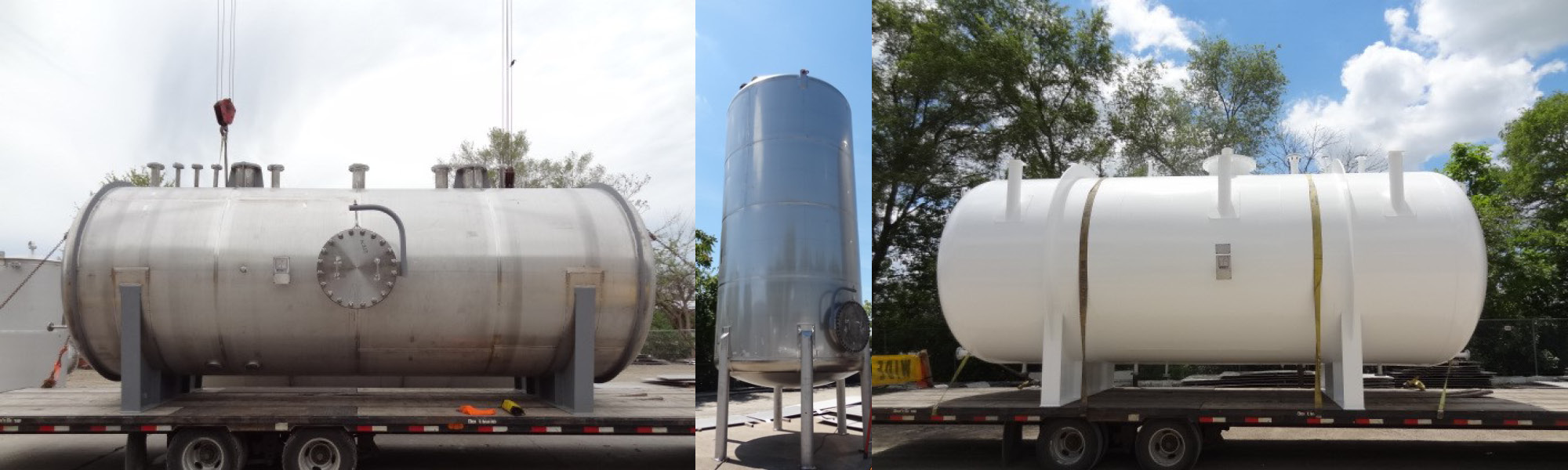
ASME Pressure Vessels in the Chemical Industry: The Specs & Guidelines You Need to Know
Whether it’s your job to manage a chemical plant, lead EHS, engineer a process change, or source new storage equipment, your pressure vessel specification is critical.
Beyond the potential regulatory issues that come with improper specification, quality-built ASME chemical storage tanks ensure that you get safe containment, reliable uptime, and a build that fits your unique process or facility requirements.
At WINBCO, we translate your chemical service, operating envelope, and site constraints into reliable custom tanks manufactured to strict ASME pressure vessel standards.
Basic ASME Tank Specifications for Chemical Processing Applications
In chemical processing, treat an ASME vessel as a system component, not simply a tank with a pressure rating. Chemical compatibility, pressure excursions, temperature, vacuum exposure, agitator loads, cleanability and inspection access all affect the design
-
Section VIII of the ASME Boiler and Pressure Vessel Code provides rules for pressure-vessel design, fabrication, inspection, testing and certification.
-
Division 1 is the usual starting point for vessels with internal or external pressure above 15 psig.
-
Division 2 can suit projects needing more detailed design rules and analysis.
What does that mean for your custom tanks? You need to establish the applicable edition, division, and jurisdictional requirements before fabrication begins. Backed by decades of ASME pressure vessel manufacturing experience, WINBCO’s experts can help you get these critical specifications right.
Start With the Process Datasheet
A strong RFQ gives us the entire design basis, not only the desired capacity. Here are a few design specs to keep in mind:
- Specify normal operating pressure and temperature, plus design pressure and temperature that cover credible cases.
- Include full vacuum or external-pressure conditions where applicable. A vessel designed only for internal pressure can be vulnerable during pump-out, condensation, blocked venting or steam-out if vacuum is ignored.
- Be precise about maximum allowable working pressure, or MAWP. Design pressure is the condition used to size the vessel. MAWP is the maximum permissible pressure at the top of the vessel at its designated coincident temperature. It is determined from the completed vessel and its governing component. Do not use those terms interchangeably in a datasheet or bid package.
Material Choice Is Also Critical
In chemical processing, the product name is only the start. To properly specify tank material you need to consider chemical concentration, impurities, operating and cleaning temperatures, moisture or chloride exposure, and potential for erosion, stress-corrosion cracking or contamination.
In other words, material choices must be evaluated against actual process chemistry and operational requirements.
Corrosion allowance requires an intentional decision. It is extra thickness reserved for anticipated material loss over the vessel’s intended life, and it does not contribute to pressure strength in the design calculations. Depending on the service, an allowance, corrosion-resistant material, lining or cladding may be appropriate. Define expected life and inspection strategy so the approach is defensible.
Specify What Drives Fabrication
You also need to define orientation and geometry, working volume, heads, nozzles, manways, drains, vents, instrument connections, supports and internals. Identify agitators, jackets, coils, platforms, lifting points and piping loads early. These details affect reinforcement, weld configuration, access, transport and installation.
Also identify nonpressure loads: liquid static head, weight, wind, seismic conditions, thermal cycles and external attachments. A vertical vessel on a skirt and a horizontal vessel on saddles distribute loads differently. Site and local requirements can materially change support and anchorage design.
Build Quality Into the PO
ASME compliance involves more than calculations. State the required Code division, materials, examination, test method, documentation, stamping and acceptance criteria. Section VIII includes requirements for materials, fabrication methods, inspection and nondestructive examination; the plan should match the service risk, not a one-size-fits-all approach.
WINBCO holds U and U2 stamps for pressure vessels. Confirm the turnover package includes the ASME data report, material traceability as specified, examination and test records, drawings, nameplate information and any operating or inspection information your project requires.
In our experience, the smoothest ASME tank projects begin with a disciplined process datasheet and an early conversation among operations, engineering, EHS, maintenance and procurement.
Key ASME Pressure-Vessel Specifications:
|
Specification
|
What to define
|
Why it matters
|
|
Code Basis
|
Section VIII division, edition and jurisdiction
|
Establishes governing construction rules
|
|
Pressure and Temperature
|
Normal, design and vacuum/external-pressure cases
|
Drives thickness and component ratings
|
|
MAWP
|
Permissible pressure at designated temperature
|
Sets a verified operating limit
|
|
Process Chemistry
|
Concentration, contaminants, temperature, cleaning media
|
Guides material and corrosion control
|
|
Corrosion Approach
|
Allowance, expected life, inspection plan
|
Accounts for service-related wall loss
|
|
Configuration and Loads
|
Nozzles, internals, supports, piping, wind, seismic
|
Prevents overlooked structural requirements
|
|
Quality Records
|
Examination, testing, Code stamp, data report
|
Documents compliant construction and turnover
|
Custom ASME Pressure Vessels at WINBCO
Contact WINBCO with your vessel specifications or submit an RFQ to consult with our experienced team on a custom ASME pressure-vessel solution for your chemical processing application.