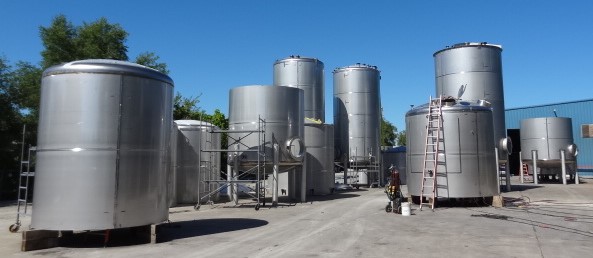
How Stainless Steel Storage Tanks Improve Product Safety: Comparing Material Options in Three Industrial Applications
In some of our customers’ use cases, the material selection for their storage tanks is not set in stone by specification or regulation. That means there’s some leeway in balancing initial cost, longevity, potential maintenance requirements, etc.
The temptation in many cases is to go with cheaper carbon steel materials, or even concrete / fiberglass in some applications, versus premium stainless steel options. Nevertheless, we find that stainless steel is often still the better choice when you truly factor in the need for long-term product safety, whether you’re working in critical industrial scenarios or commercial food storage.
The wrong material can mean contamination, corrosion failures, costly downtime, and in some industries, serious regulatory consequences. At WINBCO, we've been building custom tanks since 1939, and the material conversation comes up on virtually every project. Here's how stainless steel stacks up against the most common alternatives across three industries we know well.
1. Ethanol and Biofuel Processing: Stainless Steel vs. Carbon Steel
Ethanol is deceptively aggressive. Its hygroscopic nature means it readily absorbs moisture, and that moisture accelerates internal corrosion in carbon steel tanks faster than most operators expect.
The problem is that epoxy linings and internal coatings degrade over time. Micro-cracking, pinholing, and delamination allow product to contact bare metal, which then triggers corrosion and real contamination risk. In the emerging sustainable aviation fuel and biofuels space, contaminated batches can mean disqualified product and serious financial loss.
2. Food & Beverage Storage: Stainless Steel vs. FRP vs. Lined Carbon Steel
Food-grade storage is where material selection gets especially critical, because regulatory standards leave very little margin for error. The FDA and USDA require food contact surfaces to be non-porous, non-reactive, and cleanable, which is where alternative materials typically show their limitations.
Fiberglass (FRP) tanks are lightweight and corrosion-resistant, but FRP surfaces are inherently porous at a microscopic level. With acidic or high-temperature products, the resin matrix can leach trace compounds into stored product over time. FRP is also more difficult to inspect internally and doesn't hold up well to the aggressive clean-in-place (CIP) cycles standard in food production.
Lined carbon steel carries the same fundamental weakness we see in biofuels — the liner is the weakest link. For food applications, a coating failure isn't just a maintenance issue; it's a contamination event that can trigger product recalls and regulatory action.
-
Stainless steel (particularly 316L for more aggressive food acids) is the industry benchmark for a reason. The surface is non-porous, non-reactive, and withstands caustic CIP chemicals without degradation. At WINBCO, we build UASB reactors, fermenters, and product storage vessels for breweries, sugar refineries, and food processors…all of which demand the superior sanitation properties that quality-built stainless steel storage tanks deliver.
3. Wastewater Treatment: Stainless Steel vs. Concrete vs. Bolted Carbon Steel
Wastewater applications are unique because facilities are often balancing aggressive operating environments against tight capital budgets. Concrete tanks have long dominated municipal wastewater infrastructure: they're cost-effective at large volumes and relatively durable. But concrete is highly vulnerable to hydrogen sulfide (H2S) attack, which is common in anaerobic treatment systems. Biogenic sulfuric acid corrosion can compromise concrete structures over time, leading to remediation costs that easily dwarf the original savings.
Bolted carbon steel tanks are a frequent cost-driven alternative because they’re faster to install than poured concrete and more flexible on sizing. The tradeoff is leak risk at bolted seam joints and rapid corrosion in high-sulfide environments without consistent coating maintenance.
-
Stainless steel is the right call for high-H2S environments: anaerobic digestion systems, UASB reactors, and primary treatment stages where corrosive conditions are most intense. Resistance to both chemical and microbial corrosion extends service life significantly. In wastewater, where taking a tank offline for repairs is costly and operationally disruptive, that durability pays for itself.
We Help You Optimize Material Selection for Your Storage Needs
Across industries, the pattern is consistent: alternative materials often win on initial cost but lose on total cost of ownership. When you factor in liner replacements, coating maintenance, contamination risk, and unplanned downtime, stainless steel regularly proves to be the smarter long-term investment. At WINBCO, we help customers work through that analysis on every project.