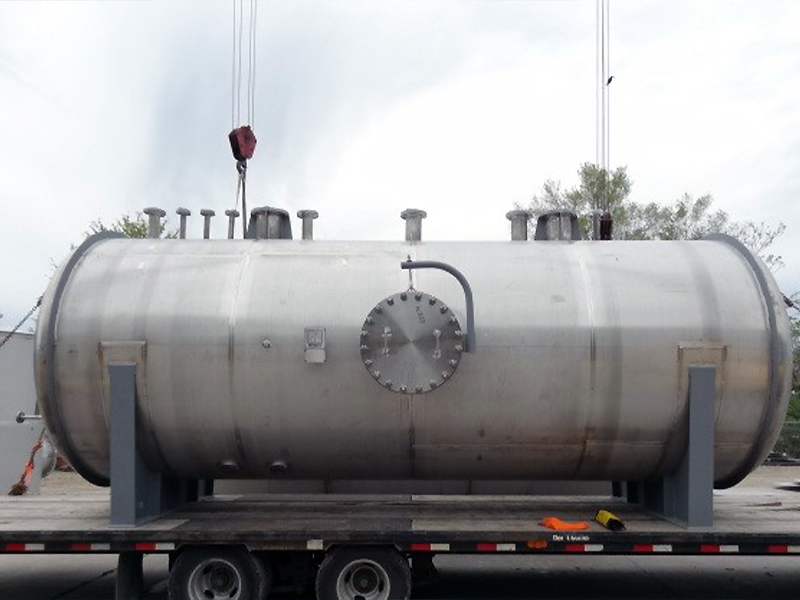
Quality Control in Tank Fabrication: Meeting API, UL, and ASME Specifications
At WINBCO, precise and specific quality control parameters are built into every stage of the fabrication process, from the first design drawing to the moment a tank ships or gets erected in the field.
Backed by more than 85 years of experience building custom tanks and pressure vessels, we understand that meeting API, UL, and ASME specifications is not just about a compliance checkbox. These specifications are in fact the foundation for quality that keeps industrial operations safe, keeps your product intact, and keeps your facility running without interruption.
WINBCO: exceeding the industry’s standards for quality in custom tank fabrication since 1939.
Our Quality Control Process: A Quick Overview
Before diving into each specification type, it helps to understand the foundation our QC program is built on. WINBCO operates under a quality management system certified to ISO 9001:2015 standards, which means every step of our fabrication process follows a documented, repeatable, and continuously improving framework.
Here is what that typically looks like in our shop:
-
Material Verification: All incoming steel and raw materials are inspected against certified mill reports before fabrication begins.
-
Welding Qualifications: All welding procedures and welders are qualified to applicable code requirements prior to production work.
-
Non-Destructive Testing (NDT): Depending on the specification, we may perform radiographic testing, ultrasonic testing, magnetic particle inspection, or liquid penetrant testing to evaluate weld integrity.
-
Hydrostatic and Pressure Testing: Finished tanks and vessels are tested to confirm structural soundness and leak-free performance.
-
Full Documentation and Traceability: Complete fabrication records, material certifications, inspection reports, and test data are compiled and available with every vessel.
Meeting API Standards
The American Petroleum Institute standards are most relevant when fabricating tanks designed for petroleum storage, production liquids, and large above-ground atmospheric or low-pressure applications.
API 650 governs welded tanks used for oil storage and operates at pressures up to 2.5 PSIG. Quality requirements here center on precise plate thickness calculations based on fluid density and design liquid level, along with rigorous weld inspection and shell-to-bottom joint integrity checks. Dimensional tolerances, plumb measurements, and settlement monitoring during hydrostatic testing are all part of the API 650 quality picture.
API 620 applies to large, low-pressure storage tanks operating up to 15 PSIG. These tanks often require more advanced engineering review, higher-grade materials, and closer attention to heat treatment and joint efficiency. The quality demands increase in proportion to the pressure and volume involved.
Meeting UL Standards
Underwriters Laboratories standards come into play primarily with tanks storing flammable and combustible liquids, which makes the quality bar especially critical. A failure in a UL-listed tank is not just a production issue. It is a fire and safety hazard.
UL 142 covers steel aboveground tanks for flammable and combustible liquids. Quality control under this standard includes tight control over tank geometry, weld quality, and leak testing. Every tank must pass a hydrostatic test to confirm the shell, heads, and all connections are fully sealed before it receives a UL label.
At WINBCO, tanks produced to UL-142 standards are fabricated, inspected, and labeled in strict accordance with UL's follow-up service procedures. That label on the tank is not just a sticker. It is the result of a disciplined quality process from start to finish.
Meeting ASME Standards
ASME standards govern pressure vessels, boilers, and pressure piping, and they represent some of the most technically demanding fabrication requirements in the industry. WINBCO holds ASME stamps including the ‘U’ and ‘U2’ stamps for pressure vessels, ‘H’, ‘S’, and ‘A’ stamps for power boilers, and the NBIC ‘R’ stamp for repairs and alterations.
Under the ASME Boiler and Pressure Vessel Codes, quality requirements include full documentation of weld procedure specifications, welder performance qualifications, and radiographic examination records. An authorized ASME Inspector reviews and signs off on each vessel prior to the ASME stamp being applied and signing the data report for each vessel.
There is no shortcutting the ASME process. Every design calculation, every weld, and every test result must be traceable and verifiable. That level of rigor is why ASME-stamped vessels are trusted in the most demanding pressure and temperature environments across chemical processing, ethanol production, food and beverage, and beyond.
Quality Tank Fabrication Services That Meet Your Required Standards
When you partner with WINBCO, you get a fabricator that takes every one of these specifications seriously. Our quality is built into the process from start to finish, engineered around the nuanced requirements of API, UL, and ASME standards, as well as the precision requirements of the industry at large.