Steel Tank Fabrication: Shop-Built vs. Field-Erected Solutions
When you're buying industrial tank equipment or sourcing a manufacturing partner, you should know whether your project is a better fit as
shop-built or
field-erected so you can begin planning and coordinating appropriately.
Should your tank be built in a controlled fabrication facility and shipped, or erected on your site?
At WINBCO, we do both, so we can tell you specifically which approach is the better fit for your application, your job site, and your tank requirements. We’re happy to provide
consultation or a custom project review. In the meantime, here are some of the main considerations you should keep in mind.
Size and Logistics Are Your Main Considerations
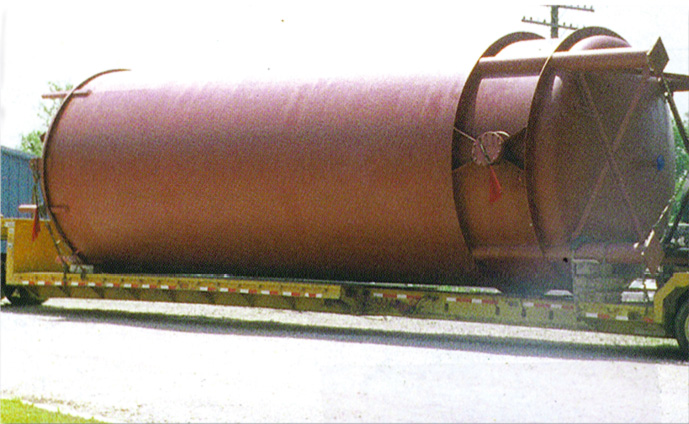
Size is usually the first filter. A shop-built tank has to travel by road, and transport limits on width, height, and weight set a practical ceiling on diameter. Once a vessel outgrows those limits, field erection is the only realistic option. Field-erected tanks can exceed 200 feet in diameter and hold millions of gallons, depending on the application.
For smaller vessels, the shop has the edge. Process tanks, day tanks, skid-mounted tanks and highly configured vessels fit comfortably within shipping envelopes. Building them indoors takes weather and site congestion out of the schedule.
Applications Where Shop-Built Tanks Excel
A fabrication shop gives you a controlled environment. Welding positions are optimized, material handling is easier, and inspection happens at a bench rather than on a scaffold. That matters when the tank has tight tolerances, polished interior finishes, or exotic alloys.
Shop fabrication is a strong fit for several of the common applications our customers bring to WINBCO:
-
UL 142 tanks for flammable and combustible liquids
-
ASME pressure vessels, where weld integrity directly affects safety and uptime
-
Stainless steel food and beverage vessels
-
Small, heavily configured tanks with many nozzles, internals, or jackets
Shop work also lets you run in parallel. While your site crew pours foundations and preps utilities, your tank is already taking shape. For fast-track projects, that overlap can pull weeks out of the schedule.
Applications Where Field Erection Has the Advantage
Field-erected tanks are the answer when scale, transport limits, or site conditions rule out a shipped vessel. Large API 650 storage tanks for oil, gasoline, and biofuels are the classic example. These are low-pressure, above-ground structures, and building them in place avoids shipping a vessel that simply won't fit on a truck.
Field erection also suits large process systems. Ethanol and corn mill facilities depend on fermentation, stillage, steep, and equalization tanks that are sized for plant throughput, not highway clearances. In these environments, the tank is part of a larger system of piping, structure, and controls, and building it in place helps it tie in cleanly.
Regarding Material Choice
Whichever route you take, material selection drives lifecycle cost more than the fabrication method does.
Carbon steel is a sound choice for many storage applications. For corrosive service, stainless, duplex, super duplex, and nickel alloys often make more sense than coated or lined alternatives. Epoxy coatings and glass linings can be more prone to expensive repairs over time, while stainless typically offers the longest service life.
Weld quality should be part of that conversation too. Ask any supplier how they verify joints. We offer 100% penetration welding to X-ray standards, and we treat inspection and testing as part of the build, not an afterthought.
Questions You Should Consider:
-
What are the diameter, height, and weight of the finished vessel, and can it ship?
-
Which code governs: API 650, UL 142, ASME?
-
What is the stored product, temperature range, and corrosion profile?
-
Does the site have access, laydown space, and utilities ready?
-
Who is responsible for erection, and is the schedule fixed?
Answers to these questions often make the decision for you. If they don't, a hybrid approach can be another option to consider. For example, we might shop-fabricate your complex components such as nozzle assemblies or internals, then integrate them into a field-erected shell.
One Partner to Simplify Your Tank Procurement Process
Splitting fabrication and erection across vendors adds handoffs, and handoffs add risk. When one company handles both, you get a single point of contact, consistent quality standards, and accountability from design through commissioning.
On site, we source our own contractors, materials, and equipment, so your operations keep running. Fixed-rate contracts help you budget without surprises.
Since 1939, we've kept to an on line, on time standard, and we've completed thousands of jobs in the past decade, with an exceptionally high percentage finishing on schedule. That track record is why procurement teams keep coming back.
Not sure whether your project should be built in the shop or in the field?
Send us your specifications through
a simple RFQ, and our team will recommend the approach that fits your application, schedule, and budget.